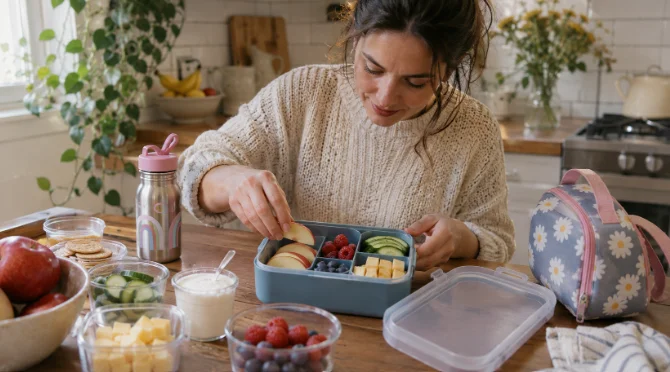
Packing a daycare snack seems straightforward until you start checking ingredient lists, allergy warnings and the food restrictions in your child’s parent handbook. A snack that works perfectly well at home may not be suitable for a shared child care environment.
Fortunately, preparing nutritious, nut-free daycare snacks doesn’t require expensive speciality products or hours in the kitchen. A few familiar ingredients, sensible food combinations and a reliable packing routine can make weekday mornings considerably easier.
What Does Your Daycare Actually Allow?
Before planning a week’s worth of snacks, check your daycare’s food policy. Some centres restrict peanuts, others exclude both peanuts and tree nuts, and some have additional restrictions involving sesame, eggs, milk or other allergens.
Child care requirements vary across Canada. In Ontario, for example, licensed child care centres must have an anaphylactic policy that addresses food brought from home and strategies for reducing exposure to allergens. Individual centres may establish additional requirements based on the children in their care.
Before your child starts daycare, ask the following questions:
- Are both peanuts and tree nuts prohibited?
- Are products labelled “May contain peanuts” or “May contain tree nuts” permitted?
- Does the centre have additional allergen restrictions?
- Are homemade snacks accepted?
- Do packaged snacks need to remain in their original wrappers?
- Is refrigeration available for food brought from home?
- Does the centre provide snacks, or are parents expected to pack them?
Having these answers before grocery shopping can prevent unnecessary purchases and last-minute changes to your child’s snack.
Peanut-Free and Tree-Nut-Free Are Not the Same
Peanuts are legumes, while almonds, walnuts, cashews, pistachios and several other varieties belong to the tree nut category recognised in Canadian food allergen labelling.
A product labelled peanut-free is therefore not necessarily tree-nut-free. An oat bar, for instance, might contain almonds without containing any peanuts.
| Packaging statement | What it means |
|---|---|
| Peanut-free | The claim specifically concerns peanuts, not necessarily tree nuts. |
| Tree-nut-free | The claim concerns tree nuts but does not automatically cover peanuts. |
| Contains almonds | Almonds are present in the product. |
| May contain peanuts | There is a potential risk of unintended peanut presence. |
| Made without nut ingredients | Does not necessarily establish that cross-contact has been prevented. |
The Canadian Food Inspection Agency (CFIA) treats peanuts and tree nuts as separate priority food allergen categories. Always check the complete label rather than relying on a single statement on the front of the package.
When Food from Home Is Restricted
Some daycare centres provide all meals and snacks themselves. Others allow food from home only for children with specific dietary requirements.
A centre may also require commercially packaged products because staff can examine the original ingredient list. Homemade banana muffins might meet the ingredient restrictions but still be unsuitable under the centre’s food policy.
If your child has a diagnosed food allergy, discuss their individual allergy management and emergency plan with the centre before their first day. A general nut-free policy is not a substitute for an individual plan.
How to Check a Packaged Snack Before Packing It
Packaged snacks can be useful on busy mornings, but familiar brands and child-friendly packaging are not reliable indicators of allergen suitability.
Developing a consistent label-reading habit is more useful than memorising a list of supposedly safe products.
Reading Ingredients and Allergen Statements
Under Canadian food labelling requirements, priority allergens present as ingredients or components of ingredients in most prepackaged foods must be identified in the ingredient list or a separate Contains statement.
Manufacturers may also use precautionary statements to indicate possible unintended allergen presence during production.
Food Allergy Canada recommends checking labels at multiple points: when purchasing a product, when putting it away at home and before serving it.
Pay particular attention to three areas of the packaging:
- Ingredient list: identifies the ingredients used in the product.
- Contains statement: identifies priority allergens present in the food when this statement is used.
- May contain statement: indicates possible allergen presence resulting from cross-contact.
The absence of a May contain statement does not guarantee that a product was manufactured in an allergen-free facility.
Granola bars, cereal products, crackers, cookies and bakery items deserve particular attention because their ingredients and manufacturing arrangements can vary considerably.
Why a Familiar Product Still Needs Checking
Food manufacturers occasionally change recipes, suppliers and production facilities. A product your child has eaten for months may have a different ingredient list the next time you purchase it.
Different flavours within the same product range can also have different allergen profiles. An apple-flavoured oat snack might meet your daycare’s requirements, while another flavour from the same brand contains almonds.
Keep the original packaging available until you have finished using the product. If you transfer crackers or cookies into reusable containers, retaining the packaging makes it easier to check ingredients again or answer questions from daycare staff.
Nut-Free Snack Ideas That Are Easy to Pack
A practical daycare snack usually combines two considerations: nutritional variety and convenience.
Fruit, vegetables, whole grain foods and protein foods provide plenty of possibilities without relying on peanuts or tree nuts. Combining a familiar carbohydrate-rich food with a source of protein or fat can make a snack more satisfying.
For toddlers younger than two, remember that nutritional needs differ from those of older children. Health Canada provides separate feeding recommendations for children between six and 24 months, while Canada’s Food Guide applies to children aged two and older.
Snacks That Do Not Require Refrigeration
Shelf-stable options are particularly useful when daycare refrigerators have limited space or when snacks need to remain in a backpack until serving time.
Possible combinations include:
- An unpeeled ripe banana and suitable whole grain crackers.
- An unopened cup of unsweetened applesauce and a soft, shelf-stable oat snack.
- Soft fruit prepared immediately before serving and suitable whole grain toast.
- An unopened shelf-stable fruit purée and an age-appropriate packaged whole grain snack.
- A soft whole grain muffin made with ingredients that do not require refrigeration after baking.
Check all packaged ingredients for allergens, and follow the manufacturer’s storage instructions. A product that can be stored at room temperature before opening may need refrigeration afterwards.
For everyday snacks, look for products made with whole grain ingredients and compare their sugar and sodium content rather than assuming every product marketed for toddlers is nutritionally similar.
Snacks for an Insulated Lunch Bag
An insulated lunch bag expands your options considerably, particularly if your child enjoys dairy products, soft vegetables or homemade spreads.
Try combinations such as soft pear slices with grated cheese, plain yogurt with mashed banana, or soft pita bread with a bean-based dip. Cooked sweet potato with finely mashed chickpeas is another option for children who prefer softer textures.
Health Canada recommends using insulated lunch bags and cold packs to keep perishable food cold. Foods requiring refrigeration should be maintained at 4°C or below.
Pack chilled food directly from the refrigerator and place a frozen ice pack beside it. If the daycare provides refrigeration, ask staff whether food can be transferred to the refrigerator upon arrival.
Hummus can be a convenient choice, but traditional hummus contains tahini, which is made from sesame seeds. Check your centre’s sesame policy before including it.
Homemade Options for Busy Weeks
Homemade snacks are especially convenient when several family members can enjoy the same batch of food.
Soft banana and oat muffins, baked oatmeal squares and unsweetened apple oat bites can be prepared using familiar ingredients. Individual portions can often be frozen and thawed as needed, following appropriate food storage practices.
Preparing nut-free snacks in a kitchen where nuts are regularly consumed requires additional care. Wash preparation surfaces, utensils, bowls and baking equipment thoroughly. Check every ingredient, including flour, oats, dried fruit and baking mixes, for relevant allergen information.
Avoid using utensils that have been in contact with peanut butter or other nut-containing spreads without thoroughly washing them first. Simply wiping away visible residue is not sufficient.
Food Allergy Canada recommends careful cleaning and preparation practices to reduce allergen cross-contact.
Five Days of Daycare Snacks
A weekly snack rotation can simplify grocery shopping without making your child’s food repetitive. Instead of buying a completely different set of ingredients for each day, choose a few versatile foods that can be used in different combinations.
The following example provides one snack per day and assumes the centre permits the ingredients listed.
| Day | Example snack combination | Preparation and storage |
|---|---|---|
| Monday | Soft oat muffin and plain yogurt | Prepare the muffin ahead; keep yogurt chilled. |
| Tuesday | Soft, ripe pear slices and grated cheese | Pack in an insulated lunch bag with an ice pack. |
| Wednesday | Unsweetened applesauce and suitable whole grain crackers | Check allergen labels and storage instructions. |
| Thursday | Soft, flattened banana oat bites and mashed berries | Prepare ahead and keep refrigerated as needed. |
| Friday | Soft pita pieces and hummus | Keep chilled and check the centre’s sesame policy. |
These combinations share ingredients with ordinary family meals. Bananas can be used at breakfast, oats in porridge, yogurt in snacks and pita bread at lunchtime.
If your child attends daycare for a full day and needs two snacks, rotate similar combinations rather than preparing twice as many recipes.
Adjust portions according to your child’s appetite, age and usual eating routine. There is no need to insist that a child finishes everything in their snack container.
Making Snacks Easier for Your Child to Eat
A nutritious snack is only useful if your child can comfortably eat it during snack time. Packaging, food texture and portion size all influence how manageable a snack is in a busy daycare setting.
If you are unsure how much variety to include, our guide to building a balanced toddler snack explains how to choose combinations that fit your child’s usual eating routine.
Containers Small Hands Can Open
Choose lightweight containers with simple lids that your child can open with age-appropriate assistance. Small compartments can keep moist foods separate from crackers or bread without requiring several individual packages.
For yogurt, applesauce and other foods that require a spoon, include a child-sized utensil if the centre asks parents to provide one.
Label reusable containers and lids with your child’s name. This helps staff identify belongings and reduces the likelihood of food being accidentally exchanged between children.
Encourage your child to eat their own snack rather than sharing or trading food with classmates.
Choosing Textures for Your Child’s Age
Nut-free does not automatically mean suitable for toddlers. Young children are still developing their chewing and swallowing skills, making certain food shapes and textures potential choking hazards.
Health Canada and HealthLink BC recommend adapting food preparation to a child’s developmental abilities, with particular care for children younger than four.
Some useful adjustments include:
- Cut grapes lengthwise into quarters.
- Cook or grate hard fruits and vegetables until they are suitable for your child’s chewing abilities.
- Grate cheese rather than serving large, firm cubes.
- Flatten soft oat bites rather than shaping them into dense, round balls.
- Mash or soften foods that your child cannot yet chew comfortably.
- Avoid popcorn, whole nuts, hard candies and other recognised choking hazards for young children.
Even appropriately prepared food should be eaten while the child is sitting upright and supervised by an adult.
A snack that suits a four-year-old preschooler may need considerable modification before it is suitable for a younger toddler.
A Quick Checklist Before You Leave Home
Once you establish a packing routine, checking your child’s snack should take little time.
Before closing the lunch bag, make sure that:
- Every ingredient complies with the daycare’s current food policy.
- Packaged foods have been checked for relevant allergens and precautionary statements.
- Homemade snacks have been prepared with clean equipment and surfaces.
- Perishable foods are chilled and packed with an ice pack when necessary.
- Food textures and shapes are appropriate for your child’s chewing abilities.
- Containers are clearly labelled.
- Original packaging is included if the centre requires it.
- Your child has access to drinking water.
If your child does not have a diagnosed food allergy, a daycare’s nut-free policy does not mean that peanuts and tree nuts need to be removed from their diet at home. Discuss individual concerns about allergen introduction or avoidance with your child’s healthcare provider.
The easiest daycare snacks are often made from foods already sitting in your kitchen. Keeping a small rotation of familiar, suitable ingredients on hand gives you enough flexibility to accommodate busy mornings, changing appetites and daycare requirements without turning snack preparation into another complicated household chore.
Leave a Reply